5 B.C.-Led Advances in Women’s Cancers
March 2, 2026
Women’s cancers have long been underfunded and understudied worldwide. On International Women’s Day, we celebrate the success of donor-supported BC Cancer breakthroughs driving change in breast, ovarian, endometrial and cervical cancers.

The survival rate for early-stage breast cancer in B.C. is now 92%.
B.C.-led innovation is helping more women not just survive but thrive after breast cancer.
- From establishing Canada’s first screening mammography program in 1988 — which reduced breast cancer incidences in B.C. by 25% — to reclassifying the disease into 10 different subtypes, BC Cancer has changed the way the world treats breast cancer.
- A recent discovery by BC Cancer’s Dr. Sam Aparicio and his team uncovered cancer-like mutations in healthy breast cells, which could help pinpoint the early genetic origins of breast cancer, leading to improved detection and prevention.
- Learn about four more donor-supported research initiatives that are advancing care for the one in eight women who will face breast cancer in their lifetime.

Genetic testing is within reach for more families in B.C.
More women are learning of their inherited risk of cancer thanks to BC Cancer’s Hereditary Cancer Program.
- Genetic testing is now being expedited for women with one or more direct relatives with ovarian cancer.
- Donor support is expanding genetic testing to all breast cancer patients under 60 to better identify BRCA gene mutations linked to significantly higher breast and ovarian cancer risk.
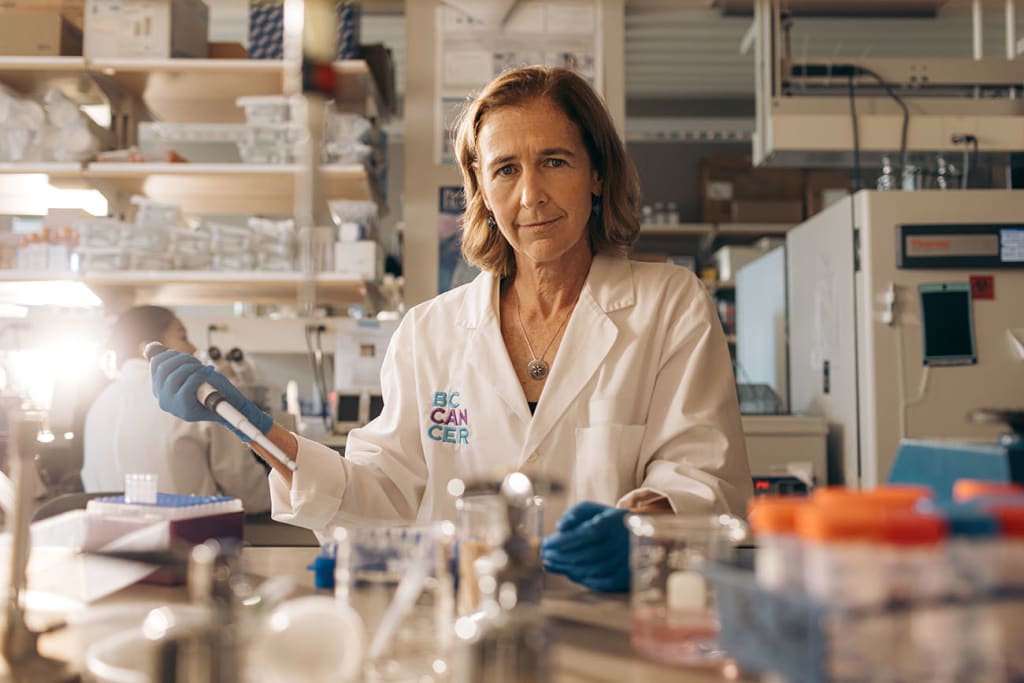
All women diagnosed with endometrial cancer will now know their subtype.
A made-in-B.C. classification tool is providing women facing endometrial cancer with consistent and equitable care.
- BC Cancer’s Drs. Jessica McAlpine and Aline Talhouk developed ProMisE (Proactive Molecular Risk Classifier for Endometrial Cancer), a practice-changing classification tool that organizes endometrial cancers into four subtypes.
- Prior to ProMiSE, endometrial cancer was classified by how tumours looked under a microscope. While this works for ovarian cancer, it led to inconsistencies in care and over or undertreatment for some endometrial cancer patients.
- Now the standard of care worldwide, ProMisE has revolutionized care for endometrial cancer patients, guiding how patients are cared for before and after surgery, informing how much radiation or chemotherapy is needed and even allowing some patients to safely avoid treatment altogether.
- ProMisE also identifies patients who are at risk of having inherited genetic syndromes that place them at increased risk of developing other cancers.

Cervical cancer is on the cusp of being eliminated.
BC Cancer’s cervix self-screening option is providing women with more equitable, accurate and convenient access to life-saving cervical cancer screening.
- From establishing the first cervical screening program in the world in 1955 — which has led to a 61% decrease in cervical cancer incidence in B.C. — to launching a first-in-Canada province-wide cervix self-screening option in 2024, BC Cancer is leading the charge to eradicate cervical cancer.
- BC Cancer’s new self-swab kit screens for the presence of HPV, the cause of 99% of cervical cancers. HPV testing is more accurate and more sensitive than traditional Pap tests and can be completed at home or at a health care provider.
- From Feb. 2024 to Nov. 2025: 240,000 self-screening kits were sent to eligible people in B.C., 34% of which were requested by people who had never been screened for cervical cancer before.

Women at risk of ovarian cancer can now stop the disease before it starts.
A B.C.-developed surgery, now used worldwide, is allowing women to significantly reduce their risk of developing the most common and deadliest form of ovarian cancer by 80%.
- After BC Cancer’s OVCARE discovered that ovarian cancer is multiple distinct subtypes, and that most ovarian cancers originate in the fallopian tubes, Dr. Dianne Miller developed the world’s first ovarian cancer prevention strategy: opportunistic salpingectomy (OS).
- OS removes the fallopian tubes, often during other pelvic or abdominal procedures, eliminating the tissues where most ovarian cancers start.
- In 2022, the OVCARE team received international recognition for pioneering a major breakthrough in ovarian cancer prevention.
- OVCARE is now aiming to increase uptake of OS, during routine surgeries such as a hysterectomy, through patient and physician educational outreach programs — which could prevent thousands of ovarian cancer cases worldwide each year.

Be the Change in Women’s Cancers
Your support helps BC Cancer researchers drive real transformation in early detection, prevention and treatment of women’s cancers.