close
News and Breakthroughs
How can I donate?
What events are happening?
Where does my money go?
See other stories

    flyout blocks

    Participate or donate to a fundraising event to support breakthrough cancer research in BC.

    flyout blocks

    See how your donations are being used to enable the great work at the BC Cancer Agency to continue.

    flyout blocks

    Read the latest news and research breakthroughs happening at the BC Cancer Agency

    flyout blocks

    Your donations support innovative cancer research and compassionate enhancements to patient care.

    As scientists, the moments of discovery when you know something that no one else in the world knows carry us.

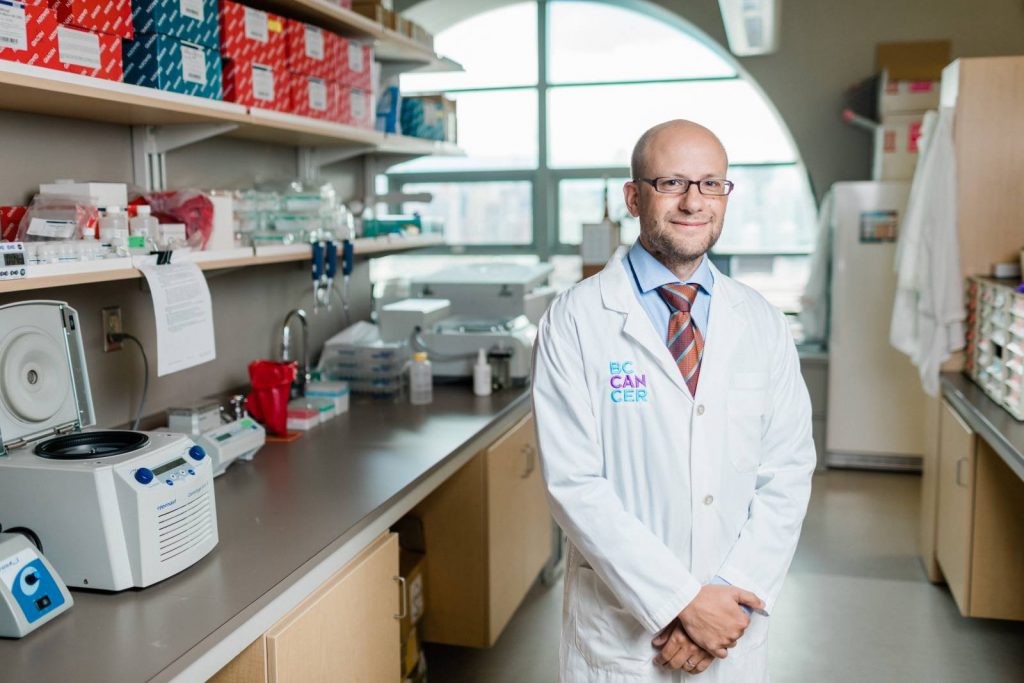
    In my career there is a moment that will always be etched in my mind: when my technician Jean showed me the data of a new drug we were testing in a lab model of advanced prostate cancer. She was excited after just three weeks some of the tumours had shrunk so much they were difficult to find. Our drug was making the tumours go away.

    The photos she showed me were amazing. The tumours treated with placebo were big, bloody and ugly, while those treated with our drug were tiny and white in colour. I stared at the photos for the longest time and then ran around the research building showing them to anyone I could find. Their jaws dropped, too clearly we were onto something that could impact prostate cancer patients.

    Our work is complex and expensive, and only made possible by generous donations. Prostate cancer is the leading cause of cancer death in North America, so our made-in-B.C. discovery has generated enormous and worldwide interest from drug companies and clinicians. Most importantly, for patients in Canada and around the world, it represents hope within grasp.

    Read Marianne Sadar's Story
    Watch Marianne Sadar's Story
    Watch video
    "As scientists, the moments of discovery – when you know something that no one else in the world knows – carry us."

    You are here

    Research Discoveries

    Apr 18, 2012

    Scientists at the BC Cancer Agency and Cancer Research UK have reclassified breast cancer into 10 completely new categories based on the genetic fingerprint of a tumour in the largest genetic breast cancer study ever performed. This new “encyclopedia” of breast cancer could change the way the disease is diagnosed and form the basis of next-generation treatments. The study offers much-needed...

    Apr 04, 2012

    BC Cancer Agency scientists decode the genetic make-up of triple negative breast cancer, which could lead to more effective treatment. The study, published in the international journal Nature, reveals that this form of cancer is not one distinct single entity, but an extremely complex and evolved tumour with an unprecedented range of mutations. Operating with the complexity of a mini ecosystem...

    Dec 21, 2011

    Drs. David Huntsman and Gregg Morin link rare, unrelated cancers (ovarian, uterine, and testicular tumours) to a single genetic mutation in DICER1. The discovery shows that the mutations change the function of DICER so that it participates directly in the initiation of cancer. This breakthrough is particularly pivotal because it could lead to solutions for treatment of more common cancers. The...

    Aug 23, 2011

    Dr. Karen Gelmon released promising clinical trial results in treating women with high-grade serous ovarian cancer with PARP inhibitors. Twenty-four per cent of the advanced ovarian cancer patients who do not have the BRCA hereditary cancer mutation responded to the treatment. As well, forty-one per cent of the patients with a BRCA gene mutation had their tumours shrink substantially. The...

    Jul 27, 2011

    A team of researchers at the BC Cancer Agency, including Dr. Marco Marra and Dr. Ryan Morin, identified a significant number of new genetic mutations involved in non-Hodgkin lymphoma (NHL). Researchers sequenced the entire genome of lymphoma cancer cells from 14 NHL patient samples and the ‘active’ genes from 117 NHL patients to search for genetic mutations specific to cancer cells. The...

    Jul 12, 2011

    Dr. Keith Humphries and researchers from the BC Cancer Agency’s Terry Fox Lab pinpoint a previously unknown gene —MEISI— as a susceptible target for combating many forms of leukemia. Dr. Humphries discovered that MEIS1 allows normal cells in the bone marrow to transform into cancerous cells. When the researchers remove MEIS1 from leukemic cells in the lab, they are able to stop very...

    Mar 23, 2011

    Researchers at the BC Cancer Agency discover a significant connection between the spread of breast cancer and a natural enzyme, called CA9. This discovery proves CA9 is a major target in tumour survival and growth in over 50 per cent of the deadliest forms of breast cancer and 16 per cent of all breast cancers – researchers can now halt the spread of these tumours through the use of novel...

    Mar 02, 2011

    Researchers at the BC Cancer Agency’s world-renowned Centre for Lymphoid Cancer identified a single gene, CIITA, implicated in two types of lymphoma - mediastinal B-cell lymphomas (a type of non-Hodgkin lymphoma) and all Hodgkin lymphoma cases - and described how it defeats the body’s immune system.

    Feb 18, 2011

    Dr. Sam Aparicio, the Agency’s head of breast cancer research, co-led a UK-based study that discovered a new cancer-causing gene, ZNF703, that when overactive, triggers the development of a particularly aggressive type of breast cancer. Patients could be tested for ZNF703 over activity, so their treatment could be tailored accordingly, and larger studies could pave the way for developing...

    Dec 21, 2010

    A study in The Lancet showed that, when compared with 12 jurisdictions from six countries of similar wealth and healthcare structures (Australia, Canada, Denmark, Norway, Sweden and the United Kingdom), British Columbians have the best one- and five-year survival rates for ovarian cancer and the best five-year survival rates for breast cancer.

    Pages